
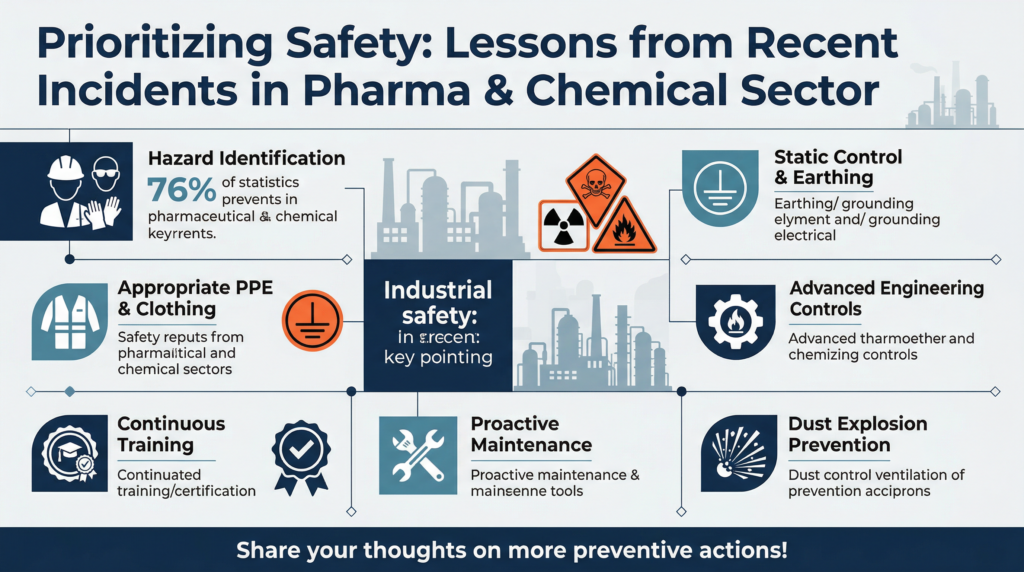
As National Safety Week is observed across India, it is an appropriate moment for the pharmaceutical and chemical industry to reflect on recent incidents and reinforce our commitment to process safety and risk prevention.
Recent industrial accidents in and around Hyderabad’s pharma and chemical clusters remind us that safety failures rarely arise from a single mistake. Our deepest condolences to the families and colleagues affected by these tragic incidents. The most meaningful tribute we can offer is to strengthen awareness and ensure that the lessons learned prevent similar events in the future.
Over the past year, the region has witnessed several serious incidents, including a major explosion in June 2025, along with warehouse fires, gas leaks, reactor over-pressurization events, and localized blasts. These incidents highlight systemic vulnerabilities that must be addressed with urgency.
Key Safety Risks That Demand Immediate Attention
1️⃣ Static Charge Accumulation
Static electricity remains one of the most underestimated ignition sources in flammable liquids – handling environments.
Precautions must include:
• Verified bonding and grounding of reactors, tanks, drums, and transfer lines
• Routine earthing resistance testing
• Use of anti-static hoses and transfer systems during charging operations
• Controlled flammable liquids transfer velocities to minimize static generation
Even a small static discharge in a flammable vapor atmosphere can trigger catastrophic ignition.
2️⃣ Combustible Dust & Dust Explosion Risks
Many API and chemical intermediates generate combustible dust during milling, drying, and charging operations. When dispersed in air, these can create explosive atmospheres.
Critical safeguards include:
• Effective dust extraction and housekeeping programs
• Avoidance of dust accumulation on beams, ducts, and equipment
• Explosion vent panels and isolation systems in high-risk equipment
• Strict control during handling of metallic powders and reactive solids
Dust explosions are high impact yet highly preventable events.
3️⃣ Runaway Reactions & Thermal Instability
Runaway reactions remain a major cause of reactor explosions in the chemical industry.
Essential precautions include:
• Comprehensive reaction calorimetry and thermal hazard studies
• Understanding adiabatic temperature rise and decomposition thresholds
• Reliable temperature interlocks and emergency quenching systems
• Adequate cooling capacity and redundancy
Production targets should never precede reaction safety understanding.
4️⃣ Hazardous Material Handling
Many pharmaceutical intermediates involve flammable solvents, toxic gases, and reactive chemicals.
Robust safeguards must include:
• Continuous gas detection and alarm systems
• Proper segregation and storage of hazardous materials
• Clearly defined LEL monitoring in flammable liquid zones
• Strict permit-to-work systems for confined spaces and hot work
5️⃣ Competency & Process Discipline
Engineering controls are only effective when supported by trained personnel.
Organizations must strengthen:
• Operator certification for reactor operations
• Management of Change (MOC) systems
• Emergency response drills
• Independent process safety audits
Safety Must Be Engineered — Not Assumed
Industrial growth without process safety maturity is unsustainable. Static discharge, combustible dust, runaway reactions, and hazardous material mismanagement are well-known risks, yet they continue to cause preventable tragedies.
Every incident provides lessons. Every near-miss is a warning signal.
As we mark National Safety Week, the responsibility lies with industry leadership, engineers, and safety professionals to build systems where risk identification, engineering safeguards, and operator competence work together to prevent disasters.
What additional measures should the pharma and chemical industry institutionalize to strengthen process safety?
#NationalSafetyWeek #ProcessSafety #StaticElectricity #DustExplosion #RunawayReaction #IndustrialSafety #PharmaSafety #ChemicalSafety #SafetyCulture